Does Bournemouth Have The Smallest Stadium In The 26/27 Europa League?

Vitality Stadium in Bournemouth, England during a game between Bournemouth and Sheffield United on March 9, 2024 - Photo by Alex Lott
AFC Bournemouth will play in the Europa League.
For the first time in the team’s 127-year history, Bournemouth has made a Union of European Football Associations (UEFA) tournament. It’s a remarkable story, as it was on the brink of losing its Football League status in 2009. For those unaware, Football League status means the team is a full-time professional club operating in the top four levels of the Football League - Premier League, Championship, League One, and League Two.
The team’s finances were in dire straits, leading to a 17-point penalty for the 08/09 League Two season. Bournemouth were able to escape being relegated to non-League Football in their second-to-last game of the season with a goal from team icon Steve Fletcher. It was sold to a new ownership group in June 2009.
Since 2009, the team has had three owners: Eddie Mitchell from 2009 to 2013, Maxim Demin from 2013 to 2022, and Bill Foley, who bought the team in December 2022.
Now 17 years later, Bournemouth is in the Premier League, the top level of English Football, and finished in the best league placement in its history - sixth. This means it has qualified for the UEFA Europa League, the second-tier of football club competition in Europe.
What is hilarious to me, an American Bournemouth fan since 2016, is that it is playing in a European Competition despite having the smallest stadium in the Premier League.
Dean Court, now known as Vitality Stadium, has been Bournemouth’s home pitch since 1910. It currently has a capacity of 11,307 fans, almost 6,000 fewer than the team with the second-lowest number of seats, Brentford. The other eighteen teams in the Premier League this past season (25/26) had ground capacities of over twenty thousand.
It got me thinking about whether Bournemouth would have the smallest stadium in the upcoming Europa League season. Spoiler alert: it does not.
Žilina: 10,572
Žilina hails from Slovakia in the town the team is named after. Founded in 1908, it plays in the Slovak First Football League. From 1945 until 1993, Žilina played in the Czechoslovak League, returning to the Slovak League after the dissolution of Czechoslovakia. It’s only been in one season of second-level Slovak football since 1993.
It got to the group stage in the Champions League in the 10/11 session and the Europa League in the 08/09 season. Both times Žilina failed to make it further. The other six appearances in the Champions League, seven in the Europa League, and three in the Conference League led to qualifying round eliminations. However, it did make it to the quarterfinals of the 1961/62 Cup Winners’ Cup, a defunct UEFA competition of domestic cup winners.
Žilina’s stadium is the Štadión pod Dubňom, which it has resided in since its creation in 1941. Štadión pod Dubňom has 10,572 seats. Renovations of the four grandstands happened between 2006 and 2009 due to UEFA requirements. To compete past the play-in stages of all three UEFA club competitions, stadiums must meet UEFA’s category four standards. Luckily for Žilina, Štadión pod Dubňom’s renovations comply with these standards.
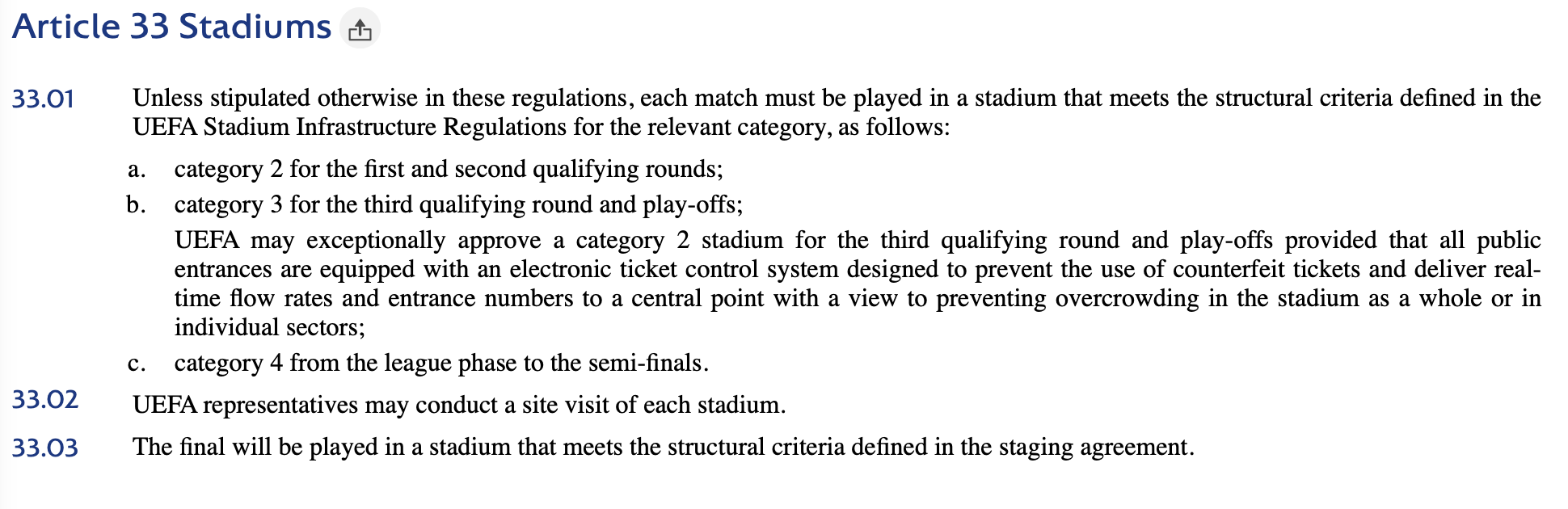
Screenshot of the stadium regulations in the Europa League for the 26/27 competition - source UEFA
Lillestrøm: 10,540
A Norwegian club based just outside of Oslo, Lillestrøm just won promotion to the Eliteserien for the 2026 season, the top level of Norwegian Football, after being in the OBOS-ligaen in 2025. It was previously in the Eliteserien from 2021-2024.
Norway’s football season differs from the traditional season in other European countries, operating from March to December instead of September to May in the following year. This is due to the horrible Norwegian winter conditions. Thus, Lillestrøm could play some Europa League games outside of the traditional Norwegian football window in frigid conditions.
Lillestrøm aren’t strangers to UEFA competitions, playing in Europa nine times previously, their most recent being in 18/19. It also played five times in the Champions League, although not recently, their last appearance being the 02/03 season. Their most recent UEFA competition appearance was in the 22/23 iteration of the Conference League.
Its home base is Åråsen Stadion, where it has played since 1951. It was most recently renovated in 2002 and has room for 10,540 spectators, although not all of them have seats. Only 7,903 general admission and 737 VIP luxury boxes have seats. For the other 1,900 fans at a full-capacity game, Åråsen has a standing room area.
Pafos: 9,394/10,830
Pafos is the reason I wasn’t able to get this article out sooner. I had to wait for the Cypriot Cup Final between Pafos and Apollon Limassol to happen on May 29th. Pafos won, which is why it is included.
It is an interesting club, founded in 2014 after the merging of the teams Paphos and Kouklia in the Paphos district of Cyprus. Despite its brief history, Pafos has had success in UEFA tournaments. During the 24/25 season, after losing in the first qualifying round of Europa, Pafos had quite a run in the Conference League up to the round of sixteen. This past season (25/26), Pafos made it all the way to the league phase of the Champions League after entering in the second qualifying round.
Stelios Kyriakides Stadium is Pafos’ main stadium, with a seating capacity of 9,394. It was built in 1985 and has had many residents, including Paphos and Kouklia, before they merged into Pafos. However, the stadium does not meet UEFA’s category three standards. Plans are in place to modernize Stelios Kyriakides, but it won’t be finished in time for the start of the Europa League.
In their previous European campaigns, Pafos used the category four Alphamega Stadium in the Limassol District. Three other Cypriot teams - Limassol AEL, Apollon, and Aris - call it their home. Alphamega has a capacity of 10,830 fans, and Pafos will most likely continue using it during their time in Europa.
Tromsø: 6,691
Another Norwegian team, Tromsø was founded in 1920 and finally made Eliteserien in 1986. Over the past forty years, it has mostly stayed in the first division of the Norwegian Football League, immediately earning promotions after getting relegated. Tromsø is one of the northernmost teams in Norway, over 300 miles north of the Arctic Circle.
Tromsø has appeared in the Europa League seven times in their history, but have only made it to the group stage. It also appeared in the 24/25 edition of the Conference League, where it was eliminated in the third qualifying round. Speaking of being above the Arctic Circle, Tromsø played a match against Chelsea during the 97/98 Cup Winners’ Cup, the second-to-last iteration of the competition, which was infamous for the amount of heavy snowfall during the game.
Romssa Arena has been the home of these Arctic residents since 1987. It has the distinction of being the second northernmost stadium ever used in European competition (the northernmost is also in Norway). The capacity at Romssa Arena is 6,691 spectators, so if Tromsø makes it to the league phase, it could be in some trouble. Category four stadiums need to have room for 8,000 spectators, so unless Romssa Arena magically spawns 1,309 seats, Tromsø will have to play their home games at a different stadium.
This also applies to the remaining entries in this article.
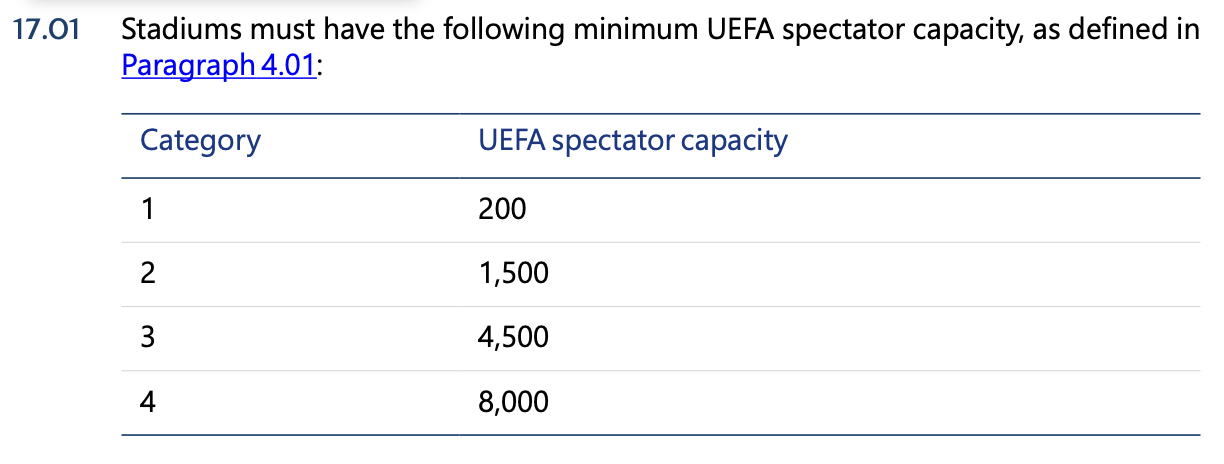
Chart of minimum spectator capacity for each UEFA category - source UEFA
Derry City: 6,300
When one thinks of Derry City, the popular Netflix show Derry Girls probably comes to mind. I’ve never seen it, but I’ve heard good things about it.
Anyway, back to Derry City, the football team. It was founded in 1928 and is the only Northern Ireland team in the League of Ireland. Derry City did play in the Irish League, the league in Northern Ireland, but moved to the League of Ireland in 1985 because The Troubles prevented it from playing in the Irish League.
It was expelled from the League of Ireland in 2009 due to financial reasons, but a new board and chairman allowed it to re-enter in 2010. Besides demotion in 2010 to the First Division, Derry City has remained in the League of Ireland Premier Division, the top division in Irish football, throughout the 21st century.
Derry City competed in the Champions League four times, Europa ten times, and Conference three times. It never made it past the first round.
Brandywell Stadium has been the home of Derry City for its 98-year history. Renovations were made to the stadium in 2025, increasing its capacity from 3,700 to 6,300. Similar to Tromsø, Derry City must find a new stadium to play in if it makes it past the qualifying rounds.
Karviná: 4,833
Karviná is based in the Czech Republic and was technically founded in 2003. It merged with Jäkl Karviná that year, but has existed in some form or capacity since 1919. I had trouble finding English sources on the club’s history prior to 2003, but it was originally founded as a Polish team called Polonia Karwina. That team merged with Mír Karviná in 1951 when Poland and the Czech Republic were part of the Soviet Union. Essentially, the current Karviná club is a merged version of four clubs.
It began in the Regional Championship in 2003 and gradually moved up to the Czech First League. Karviná won promotion to the Czech Fourth Division in 2004, the Czech Third Division in 2006, the Czech Second Division in 2008, and their current place in the Czech First League in 2016. It has never played in any UEFA competitions.
Městský stadion in Karviná has been Karviná’s home since 2016, kind of. It did play on the older version of the stadium before it was completely redone between 2014 and 2016. Městský stadion has a capacity of 4,833, making it just big enough to be a category three stadium. Karviná will need to find a larger stadium if it makes it past qualifying.
Qarabağ: 4,677
Qarabağ is an Azerbaijani team founded in 1951. But wait - isn’t Azerbaijan in Asia? Azerbaijan is in UEFA because it was a Soviet Union republic. Qarabağ was one of the founding members of the Azerbaijan Premier League in 1992, after the fall of the Soviet Union.
It has participated in many UEFA competitions: 11 Champions League, 16 Europa League, and two Conference League. It is important to note that Qarabağ often competed in two competitions in the same year, as after being eliminated from the Champions League, it played in Europa. Qarabağ’s most successful UEFA campaigns were making it to the round of 16 in the 23/24 Europa League and the knockout phase of the 25/26 Champions League.
Because of the fight over the Aghdam region between Armenia and Azerbaijan, Qarabağ plays in Baku, Azerbaijan’s capital. Azersun Arena has been its home since 2015, and has a capacity of 4,677 spectators. Azerbaijan reclaimed the Aghdam region in 2023 and has plans for a new stadium there for Qarabağ, but has not started.
I will not elaborate further about the conflict between Armenia and Azerbaijan.
Torreense: 2,431/22,000
Torreense is the ultimate underdog story coming into the 26/27 iteration of the Europa League. Qualifying for the tournament after winning the Taça de Portugal (Portuguese Cup), Torreense will play in Europa despite being in Liga Portugal 2, the second level of Portuguese football.
The Taça de Portugal win against Sporting CP in the top league, Primeira Liga, gained Torreense its first trophy in its 109-year history. Torreense has bounced around Liga Portugal 2 and Liga 3. It has played six seasons in Primeira Liga, the most recent being the 91/92 season.
Estádio Manuel Marques has been Torreense’s home stadium since 1926. It currently has a capacity of 2,431 spectators, which is insufficient for UEFA competitions. Therefore, Torreense will play their Europa matches at the 22,000-seat Estadio Algarve, home of Louletano and a popular temporary base for teams with stadiums under renovation.
Vestri: 1,596/9,800
Vestri is the other team besides Torreense in the Europa League that is not in the top football division in their country. It won the 2025 Icelandic Cup, securing its Europa spot nine months ago.
Based in Iceland, the team was founded in 1986 and has undergone several mergers with other clubs. Vestri even stopped playing from 1996 to 2006 due to financial difficulties. However, in 2006, it merged with Ungmennafélag Bolungarvíkur and has been around ever since.
It has mostly played in the 1. and 2. deild karla, the second and third levels of the Icelandic football league system. Vestri did make it to the Besta deild karla, the top level, for the 2024 and 2025 seasons, but were relegated after the latter. This will be Vestri’s first UEFA competition appearance.
Similar to Norway, Icelandic football does not follow the traditional European football calendar. The season instead starts in April and ends in September, which is quite short, but Iceland has fewer club teams than most countries. Each level has only 12 teams.
Vestri plays at the Torfnesvöllur, now known as Kerecisvöllurinn for sponsorship reasons, and has been there since its founding in 1986. Kerecisvöllurinn has a capacity of 1,596, but only 596 seats. The other thousand spectators must stand, which makes it impossible for Kerecisvöllurinn to host Europa matches.
The only Icelandic team to make it to the group stage of an UEFA tournament was Breiðablik in the 23/24 Conference League. Breiðablik played its Conference League home games at Laugardalsvöllur in Reykjavik, which has a capacity of 9,800 seats. Vestri will most likely do the same.
Aluminij: 1,200 or 625
Based in the Slovenian town of Kidričevo, Aluminij was founded in 1946 but began competing competitively in 1956. It has bounced between the Slovenian PrvaLiga, the highest level of Slovenian football, and the Slovenian Second League during the 21st century.
Before then, Aluminij played in the Slovenian Republic League when the country was Yugoslavia. When Yugoslavia dissolved and Slovenia formed in 1991, Aluminij entered the Slovenian Football League system in the Slovenian Third League. This is Aluminij’s first UEFA competition qualification.
Športni park Aluminij has been the home of Aluminij since 1950. Its website states that the capacity is 625, but I also found an article from 2023 that says the capacity is 1,200. Whichever one is correct, Aluminij bears the distinction of having the smallest stadium amongst 26/27 Europa League competitors.
Other sources:
Sunderland, AC Milan, Juventus, Real Sociedad, Celta Vigo, Hoffenheim, Bayer Leverkusen, Marseille, Stade Rennais, AZ, Sint-Truidense, Trabzonspor, OFI Crete, Red Bull Salzburg, Rangers, Jagiellonia Białystok, Twente, Benfica, Anderlecht, Viktoria Plzeň, Beşiktaş, Paok Thessaloniki, Midtjylland, St. Gallen, Maccabi Tel Aviv, Hammarby, Hajduk Split, Vojvodina, Dynamo Kyiv, Ferencvárosi, Universitatea Cluj, CSKA Sofia, Sheriff Tiraspol, Crystal Palace
https://latitude.to/lat/42.69770/lng/23.32174https://www.worldometers.info/geography/how-many-countries-in-europe/
https://www.worldometers.info/geography/how-many-countries-in-europe/#depend
https://www.worldometers.info/geography/how-many-countries-in-asia/
https://www.worldometers.info/geography/how-many-countries-in-africa/
https://statisticstimes.com/demographics/country/kosovo-population.php
